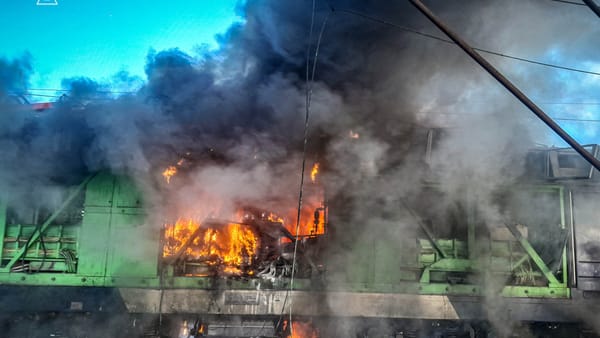
On April 14, 2022, Ukrainian-made Neptune missiles slammed into the Russian flagship Moskva and sent her beneath the waves. The coverage was breathless. Article after article stressed that this was the largest warship lost in war since the Second World War. Jubilation spread across social media. There was a sense that the date would never be forgotten, a fixed marker in the history of the war at sea.
Yet a great many naval experts disagree that April 14 was the decisive naval day of the Ukraine war, or that the sinking of the Moskva was the defining event. Instead, these analysts point to a less well-known moment, one that occurred more than six months later, and one that some argue catapulted the world into an entirely new era of warfare.
That moment came when a swarm of Ukrainian naval drones attacked Sevastopol. Using cheap, autonomous craft, Kyiv overwhelmed the port’s defenses and landed hits on two Russian vessels. But the attack went deeper than the damage it inflicted. With their daring raid, the Ukrainians may have upended everything navies thought they knew about warfare at sea.
Situation Brief
- On October 29, 2022, Ukraine sent seven naval drones, backed by nine aerial drones, in a swarm attack on Russia’s Black Sea Fleet at Sevastopol, damaging the minesweeper Ivan Golubets and the new flagship Admiral Makarov.
- Unlike the survivable, reusable uncrewed surface vessels (USVs) that state navies built through the 2010s, Ukraine’s craft are kamikaze drones designed to hit a target and detonate, echoing the fire ships of antiquity.
- Each drone is estimated to cost roughly $250,000 — the seven used at Sevastopol totaled about $1.75 million, compared to the $400 million Russia spent on a single 84-missile barrage on October 10, 2022.
- The attack forced Russia’s Black Sea Fleet into a defensive posture and prompted floating booms to be deployed as anti-drone barriers at Sevastopol and Novorossiysk.
- Skeptics argue the raid was inventive but did not amount to a revolution; the deeper worry is a future swarm of fifty or more coordinated drones that no large warship could stop.
This is the story of the rise of Ukraine’s seaborne drones, and an attempt to untangle exactly how these craft may soon transform the way nations fight on the water.
The Craft That Washed Ashore
Considering its later significance, it is remarkable how few people paid attention to the strange craft that washed ashore in Crimea in September 2022. It was a dark-colored boat roughly 5.5 meters long, designed to be uncrewed, and it was found to be carrying an explosive charge that Russian forces were obliged to neutralize.
In other words, anyone who looked could see that it was a seaborne drone, what military professionals call an uncrewed surface vessel, or USV. They could see, too, that it was almost certainly Ukrainian. Yet apart from a little speculation online, the mystery craft went mostly ignored.
That changed on October 29. That day, the seas around Sevastopol, home to Russia’s Black Sea Fleet, suddenly began to churn with activity. Footage posted to social media showed a helicopter frantically firing into the water, trying to destroy something, several somethings. There were explosions, and plumes of water kicked high into the air.
But it was the videos released later by Ukraine’s military that revealed the real chaos of that day. Shot from the front of a boat moving at high speed through the waves, the footage takes the viewer on a first-person ride through machine-gun fire, a ride that ends only when the hull of a ship fills the screen and everything goes blank.
Anatomy of the Sevastopol Raid
In the aftermath of the release, analysts were able to slowly piece the story together. In one large wave, the Ukrainians had sent seven naval drones scudding across the water to attack Russia’s fleet, while nine aerial drones provided backup. Most of the autonomous boats were destroyed by the Russians, but at least a couple got through.
One detonated against the minesweeper Ivan Golubets, damaging it. Another struck the Admiral Makarov, the new flagship of the Black Sea Fleet that had replaced the sunken Moskva. For Russian personnel stationed at Sevastopol, the day must have been one of terror.
Strangely, though, the attack passed most of the rest of the world by. Sandwiched between the far more dramatic Kerch Bridge bombing and the liberation of Kherson, the Sevastopol raid flew under most people’s radar. For media organizations, there were simply too many unknowns to report on with confidence. For audiences on social media, the grainy footage and the lack of easily memeable shots did not help.
And for Ukraine’s supporters, the revelation that damage to the Admiral Makarov was light made the assault seem almost disappointing.
Yet there was one place in the world where the October 29 attack verifiably blew minds. At naval training colleges and think tanks, people with knowledge of maritime warfare watched the footage with open mouths, not because no USV had ever attacked a ship before, but because this was the moment they had all been waiting for, the development navies had been worrying about for more than a decade. The moment that could utterly revolutionize naval warfare.
A Campaign, Not a One-Off
That excitement only grew as follow-up attacks began. On November 18, a naval drone hit the Russian port of Novorossiysk, blowing up an oil terminal. Since then, Ukraine has begun crowdfunding to buy 100 more of these USVs, producing slick videos to entice donations.
For their part, the Russians responded by beefing up their defenses. The ports of Sevastopol and Novorossiysk are now protected by layers of floating booms, simple maritime devices more often used to contain oil spills, but here repurposed as anti-USV barriers. With the appearance of the booms, the intensity of naval drone attacks dropped away. By the middle of December 2022, there had been no further follow-up strike.
Watch on WarFronts
Watch the full video analysis on the WarFronts YouTube channel, presented by Simon Whistler.
All of which might raise an obvious question. If the campaign caused only minor damage to two ships, and if the attacks have since slowed, why does any of it matter? To answer that, it helps to reach for a historical analogy.
On September 15, 1916, the British Army sent tanks into battle for the first time in history. Deployed into the chaos of the Somme, these prototypes managed to travel a mere 1.6km across the battlefield, briefly disrupting the German lines before losing everything in a counterattack. To the casual observer, the arrival of the tank therefore looked like a failure. Only the most forward-thinking would have realized they were looking at the future of warfare.
That, some very clever people argue, is exactly where the world stands today, gazing doubtfully at Ukraine’s USVs, unaware they will soon transform naval doctrine. So how, exactly, might that happen?
A Secret History of the Sea Drone
Given the speed with which aerial drones became vital components of modern warfare, it was only a matter of time before someone decided to do the same at sea. As early as 2012, the American Navy was investing in remote-controlled boats that could launch missiles and fire machine guns. Just five years later, Israel was able to deploy one of its own, using it to remotely hurl anti-tank missiles during a demonstration. By the end of the decade, those two nations had been joined by Great Britain, South Korea, China, Turkey, Greece, and even tiny Singapore in developing USVs.
But there is one big difference between those prototypes and the craft used by Ukraine: all those early naval drones were meant to survive. As the naval analyst H.I. Sutton has pointed out across multiple blog posts, the USVs of the 2010s were effectively regular craft without humans, designed for ordinary missions like minesweeping. In his words: “Explosive boat designs have been notably lacking from regular navies’ requirements lists. But those requirements were written in peacetime.”
The Ukrainian ships are a different matter. They are kamikaze drones, not intended to return in one piece but to fulfill the simple goal of hitting a target and blowing up. In this sense, they are less like the drones nation states developed over the last decade and more like the fire ships of yore, great boats filled with gunpowder, set alight, and sent floating into a line of enemy vessels. The key difference is that the Ukrainian craft can be remotely steered, allowing for complex maneuvers, though even that was not a Ukrainian invention.
Irregular Warriors and the Fire-Ship Model
The emphasis in that Sutton quote on “regular” navies is important, because while state actors focused on expensive, reusable drones, irregular forces embraced the fire-ship model. The most enthusiastic of these are probably the Houthi. Iran-backed rebels fighting Saudi-aligned forces in Yemen’s catastrophic civil war, the Houthi have a complex history of their own. What matters here is that, in 2017, they began using remote-controlled speedboats filled with explosives to attack Saudi vessels.
Famously, this included damaging an Al Madinah-class frigate in an attack that killed Saudi sailors. Since then, the Houthi have launched between 20 and 30 attacks using uncrewed kamikaze boats. Nor are they the only militia to do so. Hamas launched a similar attack in 2021, although Israeli forces were able to quickly intercept it.
From this perspective, it can look as though Ukraine’s version of these boats is nothing special, simply a European spin on a device already in use in the Middle East, especially given that Iran began developing the capability at a state level before Kyiv. But that would be to ignore the revolutionary aspect of the October 29 assault on Sevastopol.
When the Houthi launch a drone boat attack, they are being opportunists, stuffing a speedboat with explosive material and adding a crude directing device. That boat is usually on a solo mission, and its success depends entirely on no one noticing its approach until it is too late. Ukraine, by contrast, is operating on a different level. As the USV that washed ashore in September showed, these drones are specially built.
And they were deployed not alone or in pairs but as part of a swarm. A small swarm, but one operating on the same basic principle: overwhelm the defenses to such a degree that it becomes impossible to stop them all.
This is the vision of the future that naval analysts saw in the Sevastopol attack. One that is to Ukraine’s USVs what Blitzkrieg tactics were to the slow-moving tanks at the Somme. A future in which no large craft is safe from hordes of cheap surface drones that cannot be stopped. It is a vision that is both exciting and terrifying. Exciting, because it could give Ukraine an edge in its war against Russia. Terrifying, because it could equally give small states the ability to take down NATO aircraft carriers.
Inside the Machine: Cheap, Fast, and Hard to See
When you want to find out about obscure seafaring craft, the go-to place online is probably Covert Shores, run by H.I. Sutton. It was the first site to provide a full breakdown of Ukraine’s naval drones, publishing information days before Kyiv confirmed the specs. The biggest takeaway is that Ukraine really is the army of MacGyvers people claim it is.
Weighing in at 1,000kg and measuring 5.5 meters long, the USVs are lightweight and relatively fast. According to the Ukrainians, they can hit speeds of 80 km/h, or 43 knots for the more maritime-minded. And it is not specialist equipment propelling them. Covert Shores identified the engines as coming from Sea-Doo jet skis, high-end consumer kit that would cost a private buyer a lot, but is peanuts for a modern nation state.
Reportedly, they can travel distances of 800km, almost 430 nautical miles, though the figure varies by source. During that time, they can maintain autonomy for 60 hours thanks to a high-end satellite connection, possibly one of Elon Musk’s Starlink terminals. That connection does not just allow for steering. It also lets the craft’s three cameras livestream video in HD as an attack unfolds, perfect material for trolling Russia online.
The craziest part is that assembling something like this is comparatively simple. Sutton has suggested Ukrainian engineers could piece these together in a garage if needed, and do so cheaply. Kyiv estimates each drone costs just $250,000. That is a large sum for a private individual, but it is absolutely not expensive by modern military standards. A single anti-ship missile might cost several million dollars. That cheapness makes using the drones incredibly low-risk.
The Economics of Cheap Destruction
In the Sevastopol attack, Ukraine deployed seven of these USVs, at a rough total cost of $1.75 million. In return, they not only inflicted damage on a Russian minesweeper and flagship but also forced the entire Black Sea Fleet into a defensive posture, one it has largely maintained.
Operationally, that is a pretty decent win. Compare it to Russia’s mass missile attack across Ukraine on October 10, 2022. In that single bombardment of 84 missiles, Forbes estimated the Kremlin burned through $400 million worth of equipment. With such a price difference, it almost does not matter if the USVs fail to achieve their full objective.
The design itself is superbly simple. A sleek aluminum hull with two fuses at its front that, ironically, Covert Shores believes are Russian-designed. When these fuses make contact with the hull of a ship, they fire a charge that ignites a warhead hidden in the back, a warhead containing up to 200kg of explosives. So far, none of these warheads has actually sunk a ship.
The Ivan Golubets and Admiral Makarov remain afloat. But the potential is certainly there. Striking near the waterline, these drones could easily punch a hole through the side of a ship and cause it to take on water.
Being so low also confers a secondary advantage: stealth. Jutting just centimeters above the waves, the drones are extremely hard to detect with radar. Painted dark colors, they could be rendered all but invisible at night. If a wave of seven was enough to lightly damage two Russian craft, imagine what a serious wave attack of twenty, thirty, or even fifty might be capable of, all sweeping across the sea together, weaving through gunfire to impact against a hull.
It would be unstoppable. Which is why navies across the world are watching the Ukraine war very closely, to see if the revolution might not already have begun.
The Nightmare the West Saw Coming
Back in 2019, Britain’s Royal Navy formally commissioned the second of its two newest aircraft carriers, the HMS Prince of Wales. Combined with the slightly older HMS Queen Elizabeth, the total cost of the carriers came to £6.4 billion. But one political figure was less than happy with the expenditure. Dominic Cummings railed against the new carriers, calling them a waste.
In one memorable phrase, he claimed that soon “a teenager will be able to deploy a drone from their smartphone to sink one of these multibillion-dollar platforms.”
While such an extreme prediction has not come to pass, it might not be far off. Ukraine’s cheap USVs may just be the tip of the spear. This is the nightmare scenario the United States and United Kingdom have been preparing for since the Houthi launched their first uncrewed boat attack on a Saudi vessel in 2017.
Because Iran backs the Houthis and is interested in the technology, a real worry emerged that Tehran might develop the ability to sink flagship vessels should conflict erupt in the Middle East. Hence a great deal of American and British money has poured into systems for intercepting and destroying naval drones.
Those systems have evolved quickly. Had the Ukrainians, for some mad reason, launched their October 29 strike against the US Navy, all seven USVs would likely have been taken out before scoring a single hit. But seven is incredibly small for a swarm, and USV technology is likewise evolving fast.
In early December 2022, The Economist reported on Chinese attempts to develop kamikaze USVs that do not just attack individually but communicate with one another and coordinate their movements for maximum impact. To return to the Somme analogy, Beijing perfecting this technology would be like Germany developing the Panzer tank and massed formation tactics, a military hyper-leap that shakes up everything.
A Great Leveler for Small Powers
Importantly, this will not only advantage serious military powers. Right now, some analysts are looking at the Ukraine war not just as a tragedy but as a testing ground, even an incubation chamber. The old saying has it that necessity is the mother of invention, and there is no necessity like keeping a genocidal regime from destroying your nation. Just as the pandemic catapulted the development of mRNA vaccines ahead by at least a decade, Ukraine’s combination of desperation and ingenuity is turbocharging the evolution of military tactics.
What has been seen so far is extremely good news for small or medium powers threatened by a much-larger neighbor. Throughout the war, Ukraine’s defenders have shown how flexibility and willingness to adapt can help a plucky underdog punch gaping holes in what was once considered the world’s second-best military. In the naval theater, the difference has been even more pronounced.
Ukraine effectively does not have a navy, having lost 80 percent of its ships in the 2014 annexation of Crimea and scuttled the rest as the 2022 invasion began. Nonetheless, it has been able to sink the Moskva, retake Snake Island, repel Russia’s Black Sea Fleet from the coast, and now force it into a defensive posture.
Only some of that is thanks to USVs. But it does show how these sorts of advances can massively boost the fortunes of a smaller military power. Naval drones could well become a key part of this, a great leveler in future wars. At least, that is the theory.
A Tactical Mirage?
For all the hype on naval blogs following the October 29 attack, some experts remain extremely skeptical that this is the revolution people claim. The Telegraph’s Ukraine podcast recently featured a debate between Dominic Nicholls and Roland Oliphant that presented both sides without either managing to move the other. Meanwhile, King’s College London professor of war and strategy Alessio Patalano summed up the cautious mindset in a blog post for the Australian Strategic Policy Institute, writing: “Tactically, Ukrainian maritime exploits were inventive and innovative.
Operationally, they were audacious. However, they did not amount to a revolution.”
The argument against getting excited comes in two parts. One relates to the technique itself; the other to USV utility in the Ukraine war. The first has already been touched on. Fire ships have been around since antiquity, and while remote-controlling them may be relatively new, it is not as though Kyiv dreamed up a concept entirely outside the box. The second, perhaps more serious point, is that their originality hardly matters. What matters is their impact in this particular war.
On that point, the skeptics judge them to have failed. Although it is incontrovertible that the Sevastopol attack forced Russia’s Black Sea Fleet into a defensive posture, that is not the same as forcing all of Moscow’s vessels to cower in port. In the two months since the attack, Russian ships have patrolled the Black Sea. Some have even fired missiles into Ukraine, killing civilians and causing damage.
The fact they can still do this suggests these USVs are not so game-changing after all. Paraphrased, the skeptic position runs something like: show me one of these drones sinking a ship attacking Ukraine, show me these USVs forcing Russia’s entire fleet to hide in port, and then I will agree they are working.
The Verdict Time Will Render
By the time these arguments are settled, the picture may have changed entirely. As WarFronts notes, these analyses are written well in advance of events, and a great deal can shift in even a couple of weeks. But assuming no further major attack, it seems unlikely the doubters will have been won over. They might concede that the craft can harass larger vessels.
They might believe that, one day, the drones will transform naval strategy. But right now, the argument goes, they are a footnote at best, a tiny step forward on a long path toward a tactical revolution, rather than a revolution in themselves.
The frustrating part is that the world might not know which perspective is right for years to come. While huge moments in the Ukraine war have happened at sea, the sinking of the Moskva and the Sevastopol attack among them, the reality is that this is a land war. One with a naval component, sure, but a component that pales in significance next to the grueling artillery duels and trench warfare taking place.
That means the true utility of USVs may never become clear in this conflict at all. Much as it took until the Second World War for the true power of the tank to become apparent, it may not be until a large maritime war erupts that naval drones step into their own.
Still, even if things stay murky for a while, the USVs are worth paying attention to. With just a small monetary outlay and a whole load of ingenuity, Ukraine managed to do something many thought impossible: strike Russia’s Black Sea Fleet on its home turf, right in port. Even if the damage was minor, it was an astonishing feat. One that could well act as inspiration for other small powers threatened by a larger neighbor.
It is hard not to wonder what secret meetings Taiwan’s leadership must be holding about all this.
The future of USVs in naval warfare may remain an open question. But one thing is certain. Ukraine has already shown an incredible capacity to surprise the world, and who knows what else it may soon be capable of doing with its newest weapon.

Simon Whistler
Simon Whistler is one of YouTube's most prolific educational creators. WarFronts is his deep dive into geopolitics, conflict analysis, and defense strategy.
Intel Q&A
What happened during Ukraine’s October 29 attack on Sevastopol?
Ukraine sent seven naval drones, supported by nine aerial drones, in a swarm against Russia’s Black Sea Fleet at its Sevastopol base. Most of the seaborne drones were destroyed, but at least two got through, detonating against the minesweeper Ivan Golubets and the fleet’s new flagship, the Admiral Makarov. Both ships were damaged but remained afloat.
What are the technical specifications of Ukraine’s naval drones?
Each USV weighs about 1,000kg, measures 5.5 meters long, and runs on engines taken from Sea-Doo jet skis. They can reach speeds of 80 km/h (43 knots), reportedly travel up to 800km, and maintain autonomy for 60 hours via a satellite connection, possibly Starlink. Three cameras let them livestream HD video during an attack, and the warhead can carry up to 200kg of explosives.
How do the economics of these drones compare to conventional weapons?
Kyiv estimates each drone costs about $250,000 — the seven used at Sevastopol totaled roughly $1.75 million. That is trivial compared to modern military spending: a single anti-ship missile can cost several million dollars, and Russia’s 84-missile barrage of October 10, 2022 is estimated to have cost around $400 million. The vast cost asymmetry makes using the drones extremely low-risk.
Why do some experts doubt this represents a naval revolution?
Skeptics such as Alessio Patalano of King’s College London argue the raid was inventive and audacious but did not amount to a revolution. Remote-controlled fire ships are not a wholly new concept, and the drones have not sunk a ship or forced Russia’s entire fleet into port. Russian vessels still patrolled the Black Sea and fired missiles into Ukraine after the attack.
How have the Russians defended against the drones, and what is the future threat?
Russia ringed the ports of Sevastopol and Novorossiysk with floating booms — devices normally used to contain oil spills — repurposed as anti-USV barriers. With the booms in place, attack intensity dropped away. The deeper future threat, however, is a swarm of twenty, thirty, or fifty coordinated drones that overwhelm all defenses simultaneously, a scenario navies from Washington to Beijing are watching closely.
Sources
- Naval News: https://www.navalnews.com/naval-news/2022/11/why-ukraines-remarkable-attack-on-sevastopol-will-go-down-in-history/
- Economist: https://www.economist.com/science-and-technology/2022/12/07/ukrainian-ingenuity-is-ushering-in-a-new-form-of-warfare-at-sea
- Covert Shores Blog: http://www.hisutton.com/Ukraine-Maritime-Drones.html
- Covert Shores (Russian Navy defenses): http://www.hisutton.com/Russian-Navy-Defenses-Sevastopol-Novorossiysk.html
- The Strategist: https://www.aspistrategist.org.au/ukraines-drone-raid-on-russian-naval-base-was-tactically-innovative-but-not-revolutionary/
- Guardian: https://www.theguardian.com/world/2022/nov/01/could-ukraines-drone-attack-on-russian-ships-herald-a-new-type-of-warfare
- The Drive: https://www.thedrive.com/the-war-zone/ukraines-shadowy-kamikaze-drone-boats-officially-break-cover
- History, tanks at the Somme: https://www.history.com/this-day-in-history/tanks-introduced-into-warfare-at-the-somme