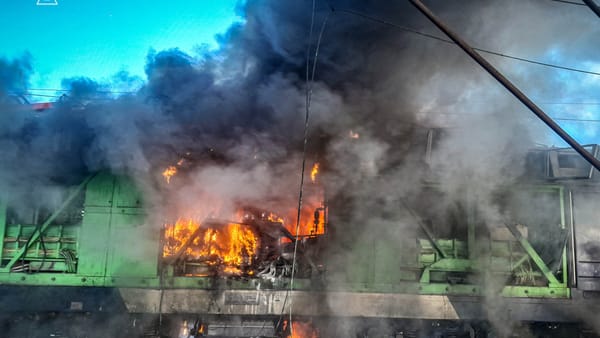

In a conflict with more than its fair share of spectacular attacks, this recent offensive may turn out to be the most spectacular of them all. On Sunday, June 1st, Ukraine unleashed multiple swarms of low-cost drones to attack Russian airbases. For the next few hours, social media was alive with imagery taken from the drones themselves as they went crashing into aircraft, sending flames shooting high into the sky. Described like that, the events of Sunday sound important, but not overwhelmingly so.
After all, Ukraine has hit Russian airbases before. As recently as March, a drone swarm caused a huge explosion at Engels airbase. But what made Sunday’s operation so transformative aren’t the broad brushstrokes of the attack; it is the unprecedented strategic execution.
Operation Spiderweb and Unprecedented Range
The specifics of this attack make it worthy of academic papers and military theory lectures for decades to come. While Engels airbase lies over 450 kilometers from Ukraine, some of the bases hit on June 1st lie over four thousand kilometers away. Nor was it a singular attack, but a combined operation that saw four airfields hit simultaneously in different corners of the country.
Situation Brief
- On June 1st, Ukraine’s Operation Spiderweb successfully struck four Russian airfields up to 4,000 kilometers away using low-cost drones.
- The unprecedented attack was orchestrated over eighteen months by Ukraine’s SBU, utilizing drones smuggled inside wooden cabins on commercial trucks.
- Estimates suggest between 12 and 20 irreplaceable Russian strategic bombers, including Tu-95s and Tu-22Ms, were damaged or destroyed.
- The loss of these heavy bombers severely hobbles Russia’s nuclear deterrent patrols and long-range cruise missile strike capabilities.
- Military analysts warn the attack exposes severe vulnerabilities at unhardened strategic bases worldwide, including US facilities in the Pacific.
According to Ukraine’s Security Service, its drones struck dozens of Russian heavy bombers across airfields in Murmansk in the Arctic, Irkutsk in Siberia, as well as Ivanovo and Ryazan in western Russia. The logistics of the attack were remarkably ingenious. Known as Operation Spiderweb, the attack took eighteen months to orchestrate.
Ukraine’s SBU secret service managed to smuggle wooden cabins into Russia with the drones concealed within the roofs. These were then delivered to their destinations by legitimate haulage firms whose drivers were completely unaware of their role. For those studying special operations, the legwork of setting up legitimate-seeming companies involved in building these cabins will be seen as a masterclass in covert action.
The key point is that the SBU managed to get hundreds of drones within easy distance of key Russian airbases without anyone suspecting a thing. The operation was carried out with these low-cost drones smuggled into Russia inside commercial long-haul trucks. Until the moment the cabin roofs retracted and the drones started flying, no one in any position of authority even vaguely suspected the trucks were anything other than normal traffic.
These drones activated when they neared their targets, launching a surprise attack that no one could foresee.
The Devastating Toll on Russian Aviation
The immediate result of the Sunday attack was the severe humiliation of Russian forces. To quote the analyst John Helin of the Black Bird Group, ‘It’s likely that Sunday was the worst day for Russian aviation since 1941.’ Overall, Kyiv claims 41 bombers were taken out, with a combined cost of seven billion dollars.
Any numbers supplied by Ukraine are obviously scrutinized, and independent consensus does not yet support that a full third of Russia’s strategic bomber fleet has been wiped out. However, Western intelligence officials reported to the New York Times that they believe up to 20 craft were destroyed or severely damaged, while Andriy Kovalenko, an official with Ukraine’s National Security and Defense Council, claims it was 13. Open source intelligence analysts using satellite imagery have counted six Tu-95s taken out, with another damaged, alongside four Tu-22Ms and one An-12.
Even if the final count comes in at twelve craft destroyed, that would not change the fact that this will have a huge impact on Russia. These were not ordinary warplanes that Ukraine targeted, but strategic bombers that are in short supply. As The Economist explains: ‘Russia has relatively small numbers of strategic bombers—probably fewer than 90 operational Tu-22, Tu-95 and newer Tu-160s in total.
Many of the aircraft are old and no longer produced—the last Tu-22M3s and Tu-95s were made more than 30 years ago.’ In other words, they are irreplaceable. And even though Russia is manufacturing Tu-160s, the process is so time-consuming and expensive that Moscow cannot simply replace them quickly.
The founder of Frontelligence Insight noted, ‘Losing even 10 would be a serious blow.’ This matters well beyond the immediate context of the conflict. These bombers aren’t designed simply to carry the cruise missiles raining destruction on Ukrainian cities.
They are intended to carry nuclear weapons and are part of Russia’s nuclear deterrent. WarZone founder Tyler Rogoway observed, ‘Russia just lost an unknown number of strategic aircraft that are directly tied to validity of their nuclear deterrent. The strategic nature of the effects of this attack puts it into uncharted territory.’
Watch on WarFronts
Watch the full video analysis on the WarFronts YouTube channel, presented by Simon Whistler.
The Historical Shift in Global Strike Capabilities
What makes Operation Spiderweb truly historic is that it confirms what military experts have been warning about for years. In the same way that forward-thinking analysts could see in 1914 that tanks were the future of warfare—yet it took until a series of spectacular victories in the summer of 1918 for politicians and wider society to catch up—the eyes of the world are now open to what was once a theoretical threat. And no one knows exactly what will come next.
The means to defend against such a threat are still in their infancy. While electronic jamming is possible, experience on the frontlines of Ukraine shows that electronic warfare is a constant arms race. There is a reason why the best defense on most of the front appears to be physical netting.
More to the point, when small drones are so cheap, there is no need to hit billion-dollar targets to make an attack cost-effective. The geopolitical landscape has entered a world in which a $600 device can take out a billion-dollar strategic asset, and there is little conventional forces can do to stop them. Such strikes may not even be the work of state-based actors.
Retired Australian General Mick Ryan noted that ‘the proliferation of drones, open-source sensors and digital command and control systems means that long-range strike is now a commodity available to almost every nation state, and non-state actor, with a few million dollars and the desire to reach out and strike their adversary.’ The inclusion of non-state actors—a category comprising outfits like the Houthis, Hezbollah, or al-Qaeda—makes this a disconcerting reality. The idea that a container full of suicide drones could one day be planted at a crowded public location by a terror group is alarming.
Over in Sudan, the Rapid Support Forces battling the army have already started using cheap drones for long-distance attacks.
Strategic Implications for the Pacific and the Kremlin
This tactical evolution is precisely what will have war planners in Washington and Beijing lying awake at night. The now very-real image of a swarm of cheap drones emerging from a hiding place near a strategic port or base before wreaking havoc represents a profound paradigm shift. What happened to Russia could just as easily happen elsewhere.
A recent Hudson Institute report bemoaned that extremely expensive aircraft are routinely left out in the open or in unhardened hangars, including at US bases at strategic locations in the Pacific—bases that would be key if conflict ever erupted with China. Tom Shugart of the CNAS think tank conjured an eerie scenario, asking observers to ‘imagine, on game-day, containers at railyards, on Chinese-owned container ships in port or offshore, on trucks parked at random properties…spewing forth thousands of drones that sally forth and at least mission-kill the crown jewels of the US Air Force.’ Shugart added that it is becoming ‘borderline-insane that we routinely allow ships owned and operated by DoD-designated Chinese military companies to sit in our ports with thousands of containers onboard and under their control.’
Despite this revolutionary shift in warfare, the overall impact of Operation Spiderweb on the current battlefield might wind up being somewhat minor. Russia’s forces are still grinding forward in the Donbas, taking immense casualties but also recruiting tens of thousands of fresh troops a month. Analyst Rob Lee summed up the reality, noting that while the war has been very costly and embarrassing for Russia, ‘bringing the war to Russia has not led to significant political pressure on Putin and Ukraine is clearly very important to Putin.’
Spiderweb joins the sinking of the Moskva or the blowing up of the Kerch Bridge as moments that humiliate Russia without immediately altering the frontline. Still, that does not mean the Kremlin will escape uninjured. With its strategic bomber force hobbled, an expensive need to search haulage trucks for drones, and its troops bogged down, Russia is starting to look less and less like a tier-one power.
As Frontelligence Insight concluded, ‘the ever-increasing cost of war may eventually compel the Kremlin to acknowledge a sobering reality: that continuing the war not only worsens the situation in Ukraine, but accelerates Russia’s own strategic decline.’ There is perhaps no clearer marker of that decline than billion-dollar platforms from the world’s self-proclaimed second greatest army reduced to ashes by low-cost drones.

Simon Whistler
Simon Whistler is one of YouTube's most prolific educational creators. WarFronts is his deep dive into geopolitics, conflict analysis, and defense strategy.
Intel Q&A
How did Ukraine execute Operation Spiderweb across such extreme distances?
The SBU spent eighteen months setting up the operation. Drones were concealed inside wooden cabins, which were then loaded onto commercial long-haul trucks and delivered by legitimate haulage firms whose drivers were entirely unaware of their cargo. When the trucks neared their targets, the cabin roofs retracted and the drones launched. This allowed Ukraine to strike four airfields simultaneously — some more than four thousand kilometers from Ukrainian territory — without any advance warning.
How many Russian strategic bombers were damaged or destroyed?
Ukraine claimed 41 bombers were taken out at a combined cost of seven billion dollars, but independent analysts using satellite imagery counted at least six Tu-95s destroyed with another damaged, four Tu-22Ms, and one An-12. Western intelligence officials told the New York Times they believe up to 20 aircraft were destroyed or severely damaged. Whatever the final tally, the aircraft are irreplaceable: Russia has fewer than 90 operational strategic bombers in total, and neither the Tu-22M3 nor Tu-95 has been in production for over thirty years.
Why does the loss of strategic bombers matter beyond Ukraine?
These aircraft are not ordinary warplanes. They are designed to carry nuclear weapons and form a core part of Russia’s nuclear deterrent. WarZone founder Tyler Rogoway observed that Russia had lost an unknown number of strategic aircraft “directly tied to validity of their nuclear deterrent,” placing the attack in what he called “uncharted territory.” The strike also forces Russia to divert resources to searching commercial trucks for concealed drones, adding a persistent logistical burden.
What does Operation Spiderweb reveal about the future of warfare?
The attack confirms that a six-hundred-dollar drone can destroy a billion-dollar strategic asset, and that existing conventional defenses have no reliable answer. Military analyst Mick Ryan noted that the proliferation of drones, open-source sensors, and digital command systems means long-range strike capability is now available to almost every nation-state and non-state actor with a few million dollars. The threat extends to terrorist groups: the possibility of a container of suicide drones planted near a crowded location is now a realistic security concern.
What is the likely strategic impact on Russia and the battlefield in Ukraine?
Analyst Rob Lee observed that while the war has been costly and embarrassing for Russia, “bringing the war to Russia has not led to significant political pressure on Putin.” Operation Spiderweb joins the sinking of the Moskva and the destruction of the Kerch Bridge as moments that humiliate Russia without immediately altering front lines. However, with its strategic bomber force hobbled and the ever-increasing cost of war mounting, Russia is starting to look less like a tier-one power — and the financial and military attrition may eventually compel the Kremlin to reckon with its own strategic decline.
Sources
- https://www.economist.com/europe/2025/06/01/an-astonishing-raid-deep-inside-russia-rewrites-the-rules-of-war
- https://www.twz.com/news-features/russian-strategic-bombers-destroyed-in-unprecedented-wide-scale-drone-attack
- https://www.france24.com/en/europe/20250602-what-we-know-ukraine-drone-strike-airbases-russia-spiders-web
- https://landsbergis.com/the-security-guarantees-europe-needs-are-being-made-in-ukraine/
- https://www.wsj.com/world/ukraines-stunning-assault-upends-russias-global-military-strategy-094f8c1c?mod=hp_lead_pos1
- https://x.com/J_JHelin/status/1929293256191312023
- https://x.com/Aviation_Intel/status/1929192006175117788
- https://x.com/tshugart3/status/1929178969330377060
- https://x.com/Tatarigami_UA/status/1929322068509639059
- https://x.com/bopanc/status/1929533889581601173
- https://x.com/RALee85/status/1929243532276941245
- https://x.com/Tatarigami_UA/status/1929271406958874662
- https://x.com/michaeldweiss/status/1929540718533480616
- https://x.com/vcdgf555/status/1929432085548486793
- https://x.com/rshereme/status/1929478901174075797
- https://www.axios.com/2025/06/01/ukraine-drone-strikes-russia
- https://www.nytimes.com/2025/06/02/world/europe/ukraine-russia-strikes.html
Related Coverage

This Is Ukraine’s Moment of Truth.
This Is Ukraine’s Moment of Truth. Introduction. Ukraine has been offered a peace—and if Ukraine accepts, then it will hand Russia the victory that it’s sa
This Is Ukraine’s Moment of Truth.
This Is Ukraine’s Moment of Truth. Introduction. Ukraine has been offered a peace—and if Ukraine accepts, then it will hand Russia the victory that it’s sa

Ukraine’s Kursk Incursion Is Over. Was It Worth It?
Ukraine's Kursk incursion humiliated Moscow and stunned the world. With the salient now largely lost, was the gamble worth what it cost Kyiv?

America Has Turned on Ukraine. Here’s Why.
Washington's turn against Kyiv upended three years of policy in a single week. What drove the reversal, and what it means for Ukraine's ability to keep fighting.