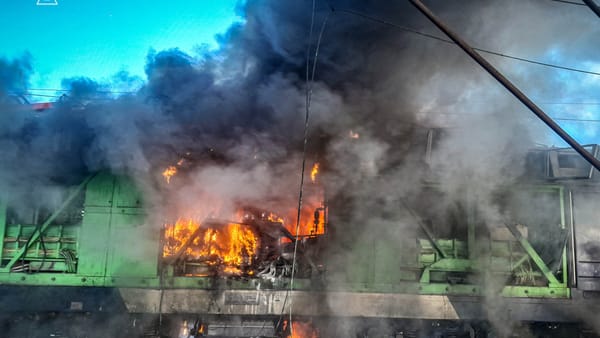

If you ever flicked on the news last year, you no doubt noticed that the talking heads were making just a bit of a big deal of the fact that Western tanks were finally being sent to Ukraine. Indeed, one only had to go to the first page of that most venerable site, Google, to be met with headlines such as: “Nato chief says Western tanks will make ‘big difference’” on Forces.net, “Why tanks could be a game-changer for Ukraine” on NPR, and “Western Tanks A ‘Vital Part of Recipe’” on Radio Free Europe. Given that Ukraine has had them for a while now, a question naturally presents itself: Have they lived up to the hype? They have certainly not hurt Ukraine’s odds — that much is beyond evident — but to call them a “game changer” might just be a bit of a stretch.
The Leopard 1: Cold War Workhorse Returns to Service
The Leopard 1 is a main battle tank developed by West Germany that entered service in 1965. Designed to prioritize speed, mobility, and firepower, it features a mighty 105mm British Royal Ordnance L7 rifled gun, advanced fire control systems, and up to 70mm of old-fashioned rolled homogeneous armour — that is, normal armoured steel, as opposed to any composite arrangement, which was only just beginning to be rolled out in some select tanks of some select militaries when the Leopard 1 debuted. There is some debate over the choice to prioritise manoeuvrability and speed over armour with the Leopard 1, but generally speaking, it is a very well-regarded tank.
This is summed up best by historian Nikola Budanovic: “Its reputation holds it as one of the most effective main battle tanks in the world.” As for which variants Ukraine received, as of the time of writing, it is currently believed to have anywhere from up to 100 of them, according to Militarnyi — “the most popular Ukrainian media outlet covering the Armed Forces” — and the Latvian Defence Academy, up to maybe as many as 270, according to a swath of articles of dubious citation. For the Leopard 1 specifically, it is very difficult to say with any accuracy how many Ukraine actually has.
Situation Brief
- Ukraine received between 100 and 270 Leopard 1s, upwards of 130 Leopard 2s, 10 Stridsvagn 122s, 14 Challenger 2s, 31 M1A1 Abrams, and 60 PT-91 Twardys from Western donors.
- At least 31 Leopard 2s have been documented as lost through open-source intelligence — 20 of the A4 variant and 11 of the A6 variant.
- Ukrainian troops acknowledged that Western tanks were vastly superior to Soviet-era platforms for one critical reason: crew survivability.
- The sole Challenger 2 loss in September 2023 shattered the tank’s perceived invincibility after two and a half decades without an enemy combat kill.
- Anton Paier assessed the Leopard 2A4 as probably not on a par with the latest Russian tanks, while praising the Leopard 2A6 as a much-improved machine with greatly improved protection.
The exact numbers pledged by Germany, Denmark, and Norway are known, but as for how many have really turned up, and in what timeframe, precision is impossible — it is not as if the Ukrainian Army ever releases a single panoramic photograph with them all in frame. The specific variants delivered include the Leopard 1A5, an upgraded version featuring a computerized fire control system and enhanced night vision capabilities for improved combat performance; the Bergepanzer 2 ARV, an armoured recovery vehicle based on the standard chassis; the Pionierpanzer 2 Dachs, an armoured engineering vehicle equipped with a dozer blade, crane, and other tools for battlefield engineering tasks; the Biber AVLB, an armoured vehicle-launched bridge system capable of deploying a bridge to allow other vehicles to cross gaps up to 20 meters wide; the Wisent 1 MC, a multi-functional support vehicle particularly adept at mine clearance; and the NM189 Ingeniørpanservogn, a Norwegian engineering variant equipped with specialized tools for military engineering tasks and battlefield support.
The Leopard 2, Stridsvagn 122, and Other Western Armour Deliveries
The Leopard 2, naturally the Leopard 1’s younger sibling, was first introduced into service with West Germany in 1979. It is known for its superior armour, mobility, and firepower compared to its forerunner. Its main armament is the 120mm Rheinmetall Rh-120 smoothbore gun, capable of firing high-penetration rounds with precision, supplemented by sophisticated fire control systems and thermal imaging.
The variants that have made it to Ukraine include the Leopard 2A4, equipped with improved fire control systems, digital electronics, and upgraded armour protection; and the Leopard 2A6, which features the 120mm L/55 smoothbore gun, further enhanced armour protection, and improved mine protection, making it one of the most advanced iterations of the series. Also delivered were the BPz3 Büffel armoured recovery vehicle and the Raivauspanssarivaunu Leopard 2R, a Finnish mine-clearing variant equipped with a mine plough and other demining equipment. A ballpark figure for how many Ukraine has would be upwards of 130, but as they have come from Germany, Poland, Norway, Portugal, Canada, Finland, and Spain, that figure should be taken as a real ballpark estimate.
Another Leopard 2-adjacent platform is the Stridsvagn 122, a heavily modified Leopard 2 developed for and used by the Swedish Army. Based on the Leopard 2A5, a standard variant that sits between the 2A4 and 2A6, it boasts enhanced armour protection including non-explosive reactive armour and additional composite screens, which provide superior defence against kinetic and explosive threats. The tank is equipped with the Rh-120 gun, along with advanced fire control systems and improved crew survivability features.
A humble 10 were delivered in September 2023. The British Challenger 2 has been in service with the British Army since 1998. It incorporates advanced Chobham composite armour, a 120mm L30A1 rifled gun, and state-of-the-art fire control systems.
Known for its exceptional durability, only two have ever been lost in combat — one to friendly fire in Iraq in 2003, and the second in Ukraine. Fourteen units were sent in March 2023. The M1 Abrams, an American tank and a cornerstone of the US Army’s armoured forces since 1980, is renowned for its advanced composite Chobham armour and multifuel turbine engine.
The specific model sent is the M1A1 SA (Situational Awareness), featuring forward-looking infrared sights, a rear-mounted telephone for infantry communication, and extra armour in the form of Abrams Reactive Armor Tiles (ARAT). Thirty-one were sent, arriving in September 2023. Finally, the Polish PT-91 Twardy — at its core a Soviet-era T-72 but designed and produced after the fall of Communism in Poland — features a dual-axis stabilized fire-control system, advanced reactive armour, a more powerful supercharged diesel engine, and a reworked automatic loader, retaining the 125mm D-81TM gun.
Sixty examples appear to have been shipped in April 2023.
Watch on WarFronts
Watch the full video analysis on the WarFronts YouTube channel, presented by Simon Whistler.
Documented Losses: What Open-Source Intelligence Reveals
While it can be difficult to say how many Western tanks Ukraine has, it is much easier to tot up how many they have lost, because the Russo-Ukrainian War is one where nearly every combatant has a smartphone in their pocket, and thus totalled tanks invariably end up getting snapped. The resultant photos find their way online — to personal social media accounts of individual combatants, or official social media accounts of various fighting organisations — at which point they are picked up by open-source intelligence operatives and compiled into cited lists. The coming figures should not be taken as totally cast iron, as there is always the chance that tanks may have been lost and somehow not been picked up on, due to either the total loss of the crew and subsequent battlefield movements seeing it go undocumented, or photos so poor that the tank pictured simply cannot be identified.
Beginning with the Leopard 1, only one is known to have been lost so far — an A5 variant knocked out and subsequently abandoned by its crew in late November 2023. The multiple explosions visible in the near vicinity, coupled with scorch marks seen around it post-abandonment, very much imply artillery was the cause rather than a mine or counter-tank fire. From the fact that all crew hatches are open post-abandonment, coupled with the otherwise good condition of it, the assumption is that all crew likely walked away alive.
Moving to Leopard 2s, at least 31 have been lost — specifically 20 A4 and 11 A6 variants. Of the A4s, 10 were complete losses, five were damaged and in a position to be recovered and potentially returned to service, and five more were damaged and subsequently abandoned. Of the 11 lost A6s, six were total losses, three were damaged and left in a position to be recovered, and two were damaged and abandoned.
Of the Stridsvagn 122, seven are known to have been lost in total: one was a total loss, apparently destroyed around December 2023, likely by direct anti-tank fire given the lack of obvious blast marks; one was damaged in a recoverable position; and five were damaged and subsequently abandoned. The American M1 Abrams has seen eight lost in total — three destroyed as total losses, one damaged in a recoverable position, and four damaged and abandoned. The Polish PT-91 has had six lost: three destroyed, one damaged and recoverable, and two damaged and abandoned.
The Contentious Destruction of Britain’s Challenger 2
The British Challenger 2 loss is just a bit contentious among the commentariat, and that is putting it mildly. One has been lost thus far, in September 2023, and there can be no doubt that it was completely and utterly destroyed — it would be a cold day in hell before that thing ever drove again. But it is not its state of destruction that is the contentious matter; it is how it was destroyed, as there is no agreement at all on this point.
The BBC, while speaking to an unnamed Western defence source, reported that it had initially been immobilised by a large mine before being targeted by a ZALA Lancet kamikaze drone that delivered the coup de grâce after its crew had bailed out. Meanwhile, Reporter, a Russian pro-government outlet, maintains that it was destroyed by a combination of artillery fire — an initial volley that immobilised it and caused an onboard fire, at which point, as it sat still, they emptied everything they had into it and left it in the state observed. Which version is true?
Truth is the first casualty in war, and while many will have a natural and understandable compulsion to distrust anything coming out of Russia, the unfortunate fact is that unless footage of exactly what happened from beginning to end emerges, or wreck analysis is released post-war, it will likely never be possible to say for certain. The reason the destruction of this Challenger 2 was such a big deal compared to others is straightforward. Owing to its advanced armour, and the fact that it went a whole two and a half decades without ever being knocked out by enemy fire, some had come to consider it something of an “invincible” tank — and this incident harshly proved there ultimately is no such thing.
Expert Assessments: Crew Survivability and Operational Challenges
The Military Lessons of the Russia-Ukraine War, published in January 2024 by the Observer Research Foundation, a Delhi-based global think tank, and edited by Kartik Bommakanti, a Senior Fellow with the Foundation’s Strategic Studies Programme, presents an overall positive picture of Western tanks in Ukraine but tempers it with pragmatic considerations of their detriments and operational challenges. As the paper notes: “Ukraine has sought and received modern tanks from NATO, although in fewer numbers than desired. The Ukrainians have faced unfortunate losses of NATO-provided tanks to Russian strikes in their attempts at regaining territory lost to Russia in Donbas, particularly in the battles for Novodarivka and Rivnopil, two villages straddling the border between Donetsk and Zaporizhzhia oblasts.”
Critically, although armoured fighting vehicle losses have been high when attempting to break through minefields up to 500 metres deep, Ukrainian troops acknowledged that Western-provided platforms were vastly superior to their Soviet-era protected mobility platforms for one critical reason: crew survivability. This survivability element is something analysts keep returning to. Anton Paier, Head of Defence Policy and Strategy at the International Centre for Defence and Security, wrote in his March 2024 paper Tanks in The Russo-Ukrainian War: “The UK has so far delivered 14 Challenger 2s to Ukraine.
While no longer state-of-the-art, the British tank is still a capable machine, particularly because of its excellent protection. But unless more vehicles are delivered in the future, it is unlikely that they will make a huge impact.” The M1 Abrams receives similar praise: “The survivability of Western-made main battle tanks, such as the M1 Abrams, in Ukraine is bolstered by their superior armor, better crew protection, and advanced electronics compared to Russian-made tanks.”
A notable exception is the Leopards, which of all the Western tanks receive by far the most criticism. Paier notes: “Most of the Leopard 2s available for transfer to Ukraine belong to the A4 version, which is over 30 years old. It is still a powerful machine but is probably not on a par with the latest versions of Russian tanks.”
However, the majority of tanks fielded by Russia are not their latest models either — for every T-80BVM or T-90M deployed, Russia also deploys, as a ballpark figure, three or four T-62s or T-72s, much older models. The Leopard 2A6 is an exception to the criticism, with Paier praising it highly: “Germany and Portugal also sent 2A6s to Ukraine. This is a much-improved machine with advanced electronics and sighting systems, and greatly improved protection.
In particular, the A6 sports the distinctive arrow-head armour modules on the turret front, already introduced on the preceding A5 model. The modifications come at the cost of increased weight, but apparently this has not significantly affected mobility.”
Training Gaps, Interoperability, and the Question of Deployment
César Pintado, writing for the International Campus for Security and Defence in August 2023, observed that Western tanks such as the Leopards, particularly the Leopard 2, experienced initial difficulties, but chalked it down to operational mistakes and inadequate training rather than inherent flaws in the vehicles. This same opinion is shared by Matthew Schmidt, a Professor of International Affairs at the University of New Haven, who notes that one should consider the established interoperability with other branches in the militaries that these tanks come from, and how that will take time to develop in the Ukrainian Army. He gives no timeframe on when he believes this synergy will be achieved, but does make it clear that he believes the Ukrainians have already made great strides in this area.
For all of this tempered praise, there are also those who sing the praises of Western tanks highly and argue that any shortcomings will not be the result of inherent design but of deployment. A great example is Gordan Davis, a former US Army Director of Operations and now senior non-resident fellow at the Center for European Policy Analysis, a think tank based in Washington DC. He said the following in January 2023 in response to the question “Does the decision to send Western tanks matter?”: “Yes, Western tanks matter.
Tanks in general could make a difference for Ukraine, but Western tanks in particular are more likely to make a difference as they can outperform their Russian counterparts. The first two key questions for Ukraine will be how many and when. Timing is critical.
It will take time to prepare, ship, transfer, train, organize for combat, and rehearse for future operations.” Davis continued: “The other critical question will be sustainability, which will be determined by the answers to several questions. For example, how well do these tanks perform in the harsh winter combat conditions expected?
How well will logisticians be able to provide the ammunition, the right parts, and sufficient fuel where and when needed? Will donor nations provide the ammunition, lubricants, and parts in a timely manner? How well will crews and units be able to keep the various tanks operationally ready?
Will there be major repair facilities with the tools and expert mechanics needed to return damaged tanks to the fight?” Although he was speaking pre-emptively, those words remain a fantastic summary of the overall position, which can be argued to this day. One solid conclusion from this discourse is that the debate is very much one of just how useful Western tanks have been to Ukraine, not whether or not they actually are.
Naturally, if one delves into the Russian side of things, there is plenty of commentary about how terrible Western armour supposedly is and how it will make no real difference to the outcome of the war — but given that essentially nothing outside of that partisan space corroborates that opinion, it does not warrant extended discussion here. The evidence, taken in full, points to Western tanks being a meaningful but not transformative addition to Ukraine’s arsenal — their true value measured less in territory gained than in crew members who lived to fight another day.

Simon Whistler
Simon Whistler is one of YouTube's most prolific educational creators. WarFronts is his deep dive into geopolitics, conflict analysis, and defense strategy.
Intel Q&A
What Western tanks were sent to Ukraine and in what numbers?
Ukraine received between 100 and 270 Leopard 1s, upwards of 130 Leopard 2s, 10 Stridsvagn 122s, 14 Challenger 2s, 31 M1A1 Abrams, and 60 PT-91 Twardys from Western donor nations including Germany, Poland, Norway, Portugal, Canada, Finland, Spain, and the United Kingdom.
What was the most significant advantage Ukrainian crews identified in Western tanks?
According to the Observer Research Foundation’s analysis of the conflict, Ukrainian troops acknowledged that Western-provided platforms were vastly superior to Soviet-era vehicles for one critical reason: crew survivability. Despite high losses among armoured fighting vehicles attempting to break through minefields up to 500 metres deep, crews in Western tanks were far more likely to survive the engagement than those in Soviet-era platforms.
How many Leopard 2s have been lost and what do the variants reveal?
At least 31 Leopard 2s have been documented as lost through open-source intelligence — 20 of the A4 variant and 11 of the A6. Analyst Anton Paier assessed the Leopard 2A4 as probably not on par with the latest Russian tanks, given that it is over 30 years old. The Leopard 2A6, however, was praised highly, with Paier noting it is a much-improved machine with advanced electronics, sighting systems, and greatly improved turret protection through distinctive arrowhead armour modules.
What made the loss of Britain’s Challenger 2 so significant?
Before Ukraine, the Challenger 2 had gone two and a half decades without ever being knocked out by enemy fire, leading some to consider it effectively invincible. When a single Challenger 2 was destroyed in September 2023 — whether by a mine and Lancet drone combination as Western sources claimed, or by artillery fire as Russian sources maintained — it shattered that perception and demonstrated that no tank is immune to the combination of mines, drones, and concentrated fire that defines this battlefield.
Did training and interoperability gaps affect Western tank performance?
Yes, according to multiple analysts. César Pintado attributed initial Western tank difficulties to operational mistakes and inadequate training rather than inherent vehicle flaws. Matthew Schmidt noted that Western tanks come with established interoperability with other branches that Ukraine would need time to replicate, though he acknowledged Ukrainian forces had already made considerable strides. Gordan Davis of the Center for European Policy Analysis emphasised that timing, sustainability, crew training, logistics, and spare parts supply were all as important as the vehicles themselves.
Related Coverage

This Is Ukraine’s Moment of Truth.
This Is Ukraine’s Moment of Truth. Introduction. Ukraine has been offered a peace—and if Ukraine accepts, then it will hand Russia the victory that it’s sa
This Is Ukraine’s Moment of Truth.
This Is Ukraine’s Moment of Truth. Introduction. Ukraine has been offered a peace—and if Ukraine accepts, then it will hand Russia the victory that it’s sa

Did Rich Foreigners Pay to Shoot Civilians in Bosnia?
Did Rich Foreigners Pay to Shoot Civilians in Bosnia? Introduction. What’s the most depressing piece of global news you’ve heard this year? There’s been pl

America Has Turned on Ukraine. Here’s Why.
Washington's turn against Kyiv upended three years of policy in a single week. What drove the reversal, and what it means for Ukraine's ability to keep fighting.

Russia May Be Planning a False-Flag Attack Against NATO.
Russia May Be Planning a False-Flag Attack Against NATO. Introduction. All warfare is based on deception, and when Vladimir Putin fights a war, deception w