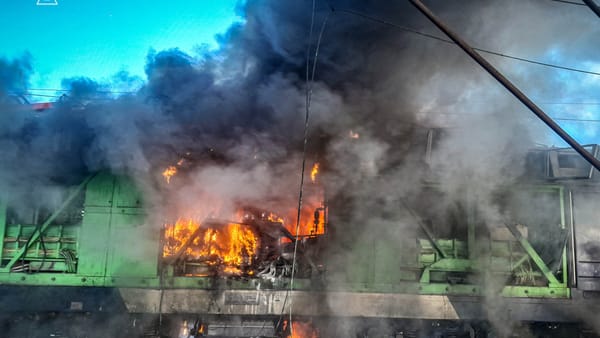

“Drone” has become one of those words that means both everything and nothing at the same time. To some it is a toy topped with a fuzzy low-resolution camera. To others it is a cruise missile with 20:20 vision. To a quartermaster it is a consumable line item, and to one of their soldiers it is either a guardian angel or a whizzing, whirring terror machine, depending on whose side it is on.
Strip all that away, however, and drones, however they come, are essentially the same thing: an uncrewed system that lets you project capability without putting a human being inside. That could mean surveillance, logistics, communications, electronic warfare, or ordinary warfare. The only thing “drone” truly denotes is the absence of an immediately involved human. Once you view them through that lens, you understand why they have proliferated so fast: a drone can scale down into a cheap-and-cheerful disposable or scale up into a boutique multi-tonne platform, and the result is always the same — more reach, more endurance, more bang.
That core simplicity is why the only interesting question left is who. Who has the best ones? Who has the worst? Who has done the best job of building drones into a proper, sustainable capability? This is a ranking of the world’s drone fleets, skewed toward airborne systems because that is where the most mature fleets, the biggest procurements and the most visible combat learning currently sit.
Situation Brief
- Owning impressive prototypes is not the same as drone power. The metrics that matter are full-spectrum breadth across air, land and sea; the industrial scale to mass-produce and sustain under pressure; an export footprint; and decades of real combat experience that hardens into doctrine.
- Europe is not a drone powerhouse. Two decades of collapsed programmes — France’s four-aircraft Harfang, Germany’s single Euro Hawk, Italy’s HammerHead, Spain’s Atlante, the UK’s Watchkeeper — forced the continent to buy American Reapers and lease Israeli Herons. The sovereign Eurodrone, first flight expected around 2027, is the great hope.
- Ukraine has changed drone warfare more than anyone since 2022, turning unmanned systems into the ordinary plumbing of war and dragging that logic into strategic strike and naval combat — but it lacks MALE/HALE platforms and any export infrastructure.
- Turkey went from buying nothing to building everything in under twenty years, from the cheap Bayraktar TB2 to the Reaper-class Akinci and supersonic stealth concepts like Kizilelma and the Anka-3.
- Israel is the quiet world leader and pioneer, with forty-plus years of experience, the Heron and Hermes families, the Harop loitering munition, and exported doctrine baked into foreign militaries from Azerbaijan to India.
The thesis is simple: real drone power is not about owning the coolest hardware — it is about industrial scale, full-spectrum breadth, and a long, ugly track record of fighting with drones and building doctrine around what worked.
The Tryers: Europe, Pakistan, India, Japan and Brazil
At the bottom sit the nations that have genuinely tried but have not yet turned serious effort into something coherent, scalable and combat-relevant. They have built prototypes, launched programmes, held press events and written doctrine papers — but the end result is still patchy.
If one region should be a drone powerhouse, it is Europe, packed with world-class aerospace firms and NATO budgets. Yet for twenty years its story has been one of programmes that collapse outright or drones built in such tiny numbers you forget they existed. France’s Harfang, an Israeli-derived design, ran to four airframes. Germany’s Euro Hawk, a Global Hawk variant, amounted to a single aircraft now gathering dust in a museum.
Italy’s Piaggio P.1HH HammerHead died with Piaggio’s financial collapse. Spain’s Atlante, first flown in 2013, quietly expired in the 2020s. And the UK spent over a decade wrestling with Watchkeeper — an indigenised Hermes 450 that reached full operational capacity in November 2018 — only to nearly immediately move to phase it out as too expensive.
So Europe gave up building and bought off the shelf instead: American Reapers for France, Spain and Italy; leased Israeli Herons for Germany. The light at the end of the tunnel is Eurodrone, agreed in principle around 2015 by Germany, France, Italy and Spain, with the big development-and-production contract signed in February 2022. It is a deliberately top-shelf, twin-engine MALE platform — an 11–12 tonne maximum take-off weight, up to 40 hours of endurance, a multi-tonne payload — built by Airbus as prime with Dassault and Leonardo, procured through OCCAR, with an initial order of 20 “systems” of three aircraft each, 60 air vehicles in total.
First flight is expected around 2027 and entry into service around 2029–2030, and its entire point is sovereignty: a European MALE drone sustainable without begging Washington or Tel Aviv for permission. Smaller green shoots exist too — France’s shipborne VSR700, Airbus’s Zephyr pseudo-satellite, Safran’s Patroller, and Spain’s reworked Atlante II at 27 airframes.
Pakistan is a story of necessity: a fragile border with India, an internal insurgency, and an uncertain relationship with an America happy to fly its own drones from Pakistani airfields but unwilling to sell. The response was the Burraq, heavily influenced by Chinese designs, which announced Pakistan’s first indigenous drone strike in 2015 — a missile hit in North Waziristan that killed three militants. Alongside it runs the Shahpar ISR line, with Shahpar-II pushing toward a true MALE system and Shahpar-III concepts shopped at trade shows. But the domestic projects do not appear to exist in large numbers, so Pakistan supplements with imports: the Italian Falco, Chinese CH-series and Wing Loong systems, and a 2020s shopping spree in Ankara that brought TB2s and the far more serious Akinci. It has proven it can conduct armed UAV strikes, but it has not built a true ecosystem.
India, on paper, should be one of the big boys, with a huge defence budget, a massive tech sector and plenty of motivating neighbours. Yet its indigenous story is an endless loop of “nearly.” Nishant, begun in the 1990s, finally entered service around 2011; four were inducted, all eventually crashed, and the project was terminated in 2015 — undone not by exotic technology but by a parachute-and-airbag recovery system that repeatedly failed. Then came the flagship Rustom-II, later TAPAS-BH-201, sanctioned in 2011 and meant to be India’s Predator. It flew hundreds of test flights but fell short on the numbers that matter: against requirements of roughly 24 hours’ endurance and above 9,000 metres, it struggled at around 18 hours and about 8,500 metres. In January 2024 the government removed it from “Mission Mode” status. India is buying 31 Reapers from the United States while Vice Admiral Krishna Swaminathan held out hope in October 2024 that “the next version of TAPAS will be much better.” On the small end, though, India does well — hand-launched scouts and quadcopters from firms like ideaForge, a few thousand micro and mini systems, and swarming trials.
Japan is shockingly behind, behind even Iran and Russia, never mind China. Not from inability — its manufacturing, electronics and robotics are world-class — but from caution. Constitutional interpretations and a political culture hypersensitive to anything resembling offensive power projection made armed drones politically radioactive. So Tokyo bought proven surveillance: three Global Hawks ordered in 2014, in service from 2022, then SeaGuardian, a navalised Reaper variant whose Maritime Self-Defence Force trials began in October 2022, with three units accepted into service in late 2024, unarmed and in the ISR role. Domestic efforts are very slow — Subaru delivered an experimental fixed-wing UAV to the ATLA agency for manned–unmanned teaming, and a “loyal wingman” for the UK-Italy-Japan sixth-generation fighter (expected 2035) is being studied. On the small end Japan fields the RQ-11 Raven, ScanEagle-type systems, and the indigenous Yamaha R-MAX helicopter drone.
Brazil is an oft-slept-on aerospace heavyweight — Embraer, Avibras, AEL Sistemas — yet its drone story is a collection of promising starts and budget reality. Avibras’s Falcao flew around 2009 and went nowhere. Harpia Sistemas, a 2011 joint venture to build a Brazilian Hermes 450 variant, was effectively dead by 2016 when government money dried up. Brazil filled the gap with Israeli Hermes 450s — used at the 2014 World Cup and 2016 Olympics — and later Hermes 900s, with at least two delivered by 2021. On the small end it does fine, with the indigenous FT-100 Horus mini-UAV. And change may be coming: in March 2025 the Brazilian Army published a competitive notice for armed tactical UAVs in the “very small UCAV” bracket — roughly 700 kg maximum take-off weight, at least 300 km control range, an 18,000 ft ceiling, and a load of either four guided 70 mm rockets or two missiles — prompting indigenous players like Stella Tecnologia and Thales’s Atoba to wave mock-ups at trade shows.
Ukraine: Unmanned Warfare as the Plumbing of War
Ukraine is the first genuinely serious player on the list — not the best, but a nation with real capabilities, real battlefield experience, real industrial depth and real strategic weight. And since February 2022 it has done one thing better than anyone: turned unmanned systems from a specialist capability into the ordinary plumbing of war. If something explodes on the front line, there is a good chance a drone had a hand in it — spotting it, ranging it, jamming it, hitting it, finishing it, or filming it.
Watch on WarFronts
Watch the full video analysis on the WarFronts YouTube channel, presented by Simon Whistler.
But Ukraine’s drone power is not a neat, exportable, full-spectrum ecosystem. It is a brutal, improvised, hyper-evolved wartime organism — astonishingly lethal, weirdly innovative, constantly mutating, and still constrained by money, logistics and parts supply because it is fighting for its life rather than building a peacetime procurement empire. Pre-2022 Ukraine had only a bland, “normal” drone story. Then the full-scale invasion landed like a meteor, and the country innovated.
At the bottom rung that meant drowning the front in cheap quadcopters — commercial DJI Mavics that became platoon-level eyeballs spotting trench lines and correcting indirect fire, then evolving into munitions-droppers, and then into FPV drones turned into screaming one-way guided munitions. The FPV is Ukraine’s most iconic contribution, the purest expression of attritional warfare: cheap, precise, mass-producible, basically an airborne IED with a live feed. Its grim genius is the cost exchange — a drone costing hundreds or a couple of thousand dollars deleting vehicles worth millions. Ukrainian drones have located and destroyed a Buk-M3 air-defence system alongside an Uragan-1 launcher, picked off a Pantsir-S1 explicitly built to kill drones, and struck a TOS-1 thermobaric launcher into a catastrophic sympathetic detonation.
Above that sit bespoke battlefield multirotors — R18-style bomber drones and the heavy-lift “Baba Yaga” class. And because Russia’s depth — airbases, depots, factories, fuel farms — still needed reaching, Ukraine built long-range one-way attack drones: prop-driven types like the UJ-22, cheaper long-range designs like the AQ-400 concept, and the Liutyi-style loitering munition, which can reach out 2,000 km and put a 75 kg warhead into something.
Ukraine’s real wild card is the sea. Starting the war with no real navy against Russia’s fleet, it has inflicted outsized naval defeats almost entirely through uncrewed surface vessels. The Magura V5 is the relatively standard explosive drone boat; the heavier Sea Baby targets the nastiest objectives, including bridge pylons and ships in port. These have evolved into gun-armed and even air-to-air-missile variants.
Underwater, the Toloka family and the volunteer-built Marichka point toward an unmanned sea-denial capability built from scratch, under fire.
Zoom out and the organisation impresses most. Ukraine turned drone production into one of its biggest industries, with the manufacturer base reportedly exploding from single digits pre-war to hundreds. It created a dedicated Unmanned Systems Forces branch — an absurdly modern move signalling that Kyiv views drones as a permanent arm of war. Its combat record is genuinely world-leading: the kill chain compressed to ridiculous speeds in a live, Darwinian environment where designs that work spread fast and designs that fail get people killed.
So why isn’t Ukraine higher? It makes no Predator- or Reaper-class MALE UCAVs — only Turkish TB2s and the in-progress Sokil-300 — has nothing in the big HALE class at all, and has no export infrastructure. On “who changed drone warfare most since 2022,” though, Ukraine would be right at the top.
Russia: A Dangerous, Noisy Bodge Job
Russia takes sixth, and placing it this far down almost feels harsh. Does it have a broad spread of drones across roles? Yes. Does it have an absurd amount of real-world experience from invading Ukraine?
Very much so. And in dark little niches — FPV kamikazes, garage lash-ups — it is arguably ahead of nations ranked higher. Yet zoom out and Russia’s drone empire looks less like a coherent ecosystem and more like a very dangerous, very noisy bodge job, dependent on imported designs, smuggled electronics and brute quantity over quality.
At the respectable end sits the Orlan-10, a 15–20 kg reconnaissance UAV from Saint Petersburg’s Special Technology Centre, catapult-launched, puttering for 10–14 hours with a cheap-but-effective camera. The Orlan-30 added an electro-optical turret and laser rangefinder, and the optional Leer-3 system jams radio and mobile communications. Thousands are thought to be in service.
Above it sits the legacy of Russia’s Israeli-buying phase after the 2008 Georgia war: the Searcher II and BirdEye 400 became the Forpost and Zastava when produced locally, with the later Forpost-R Russified with a local engine and light guided munitions. Their real significance was the industrial foothold they created.
That foothold produced the Orion (Inokhodets), Russia’s Predator equivalent — an eight-metre, 16-metre-wingspan MALE with around 24 hours’ endurance, proven in Syria with sortie marks painted down its side. The Altius is the top-spec HALE-ish model, a roughly six-tonne twin-engine platform threatened for a decade; most analysts believe a mere three exist, all prototypes. Russia, put simply, is out of its depth with big, cutting-edge UAVs — like the Su-57 and T-14 Armata, it can make great prototypes and wheel them out at parades but cannot crank them out under sanctions. Hence little excitement about the upcoming Okhotnik-B flying wing.
The smaller stuff is a very different story, and it works at scale. Beyond the Orlan-10 there is a whole small-UAV ecosystem — Eleron-3, Granat, Takhion, ZALA 421 variants — and the loitering munitions. The poster child is the Lancet from Kalashnikov’s ZALA Aero offshoot: a few tens of kilos, a 3–5 kg warhead, 30–40 km of range, trialled in Syria and then shipped to Ukraine in quantity, where it became the artillery-killer of choice against M777s, Caesars, PzH 2000s, Leopard 2s and Bradleys.
Below it sits the KUB-BLA delta-wing kamikaze, and below that the bodge tier of COTS FPVs with RPG warheads and grenades bolted on. Initially a volunteer effort crowdfunded on Telegram, the Ministry of Defence came around once results arrived, and now formal FPV companies sit in most frontline brigades, with “mothership” hexacopters, foam bomb-trucks, and tethered fibre-optic FPVs that defeat radio jamming. Commercial Mavics, Matrices and Autels are standard issue.
Sixth place, then — not because Russia’s fleet is a joke (the Rubicon elite drone unit has been devastating) but because it remains a war-footing bodge rather than a mature, self-sustaining ecosystem.
Iran: The Arsenal of Attritable Munitions
Fifth goes to Iran. The same Iran that scored few hits on Israel during the Twelve Day War — but where drones are concerned, one of the world’s key players. The seed was planted in the 1980s during the Iran–Iraq War, when the IRGC experimented with the boxy Mohajer-1, essentially a remote-controlled glider with cameras to spot Iraqi artillery. Crude, but it worked, and ever fancier drones followed: target drones, reconnaissance platforms, loitering munitions, and finally proper UCAVs.
Today Iran has serious variety. At the small end is the man-portable Meraj-521, with about 5 km of range. The headline act is the Shahed-131 and Shahed-136 loitering munitions, known worldwide from Ukraine both in their own right and as the reworked Russian Geran-1 and Geran-2: a dart-shaped delta airframe, a two-cylinder engine turning a wooden propeller, up to 50 kg of explosive, commercial-grade GPS, rocket-boosted off a ramp, flying low at 150–180 kph to hit fed coordinates with alarming precision.
The larger Kian and Arash scale that up. Above the kamikaze layer is a thick stack of reusable platforms: the Mohajer-6 workhorse (10–12 hours, two hardpoints, exported to Ethiopia, Sudan, Venezuela and Russia); the new Mohajer-10 (Reaper-ish proportions, 24 hours, 1,800 km range, 300 kg payload, rolled out in 2023 with a “prepare your shelters” warning in Persian and Hebrew); the Shahed-129 and larger Shahed-149; and the tactical Ababil family up to the Ababil-5 UCAV.
Most interesting is Iran’s stealth effort, which traces to 2011, when an American RQ-170 came down inside Iran. Whether it malfunctioned or was “taken control of” matters little — Iran reverse-engineered it. After rough prototypes (Shahed-141 and -161) came the Shahed-191, which actually flies patrols. It is at best “stealth-ish” — analysts cite panel gaps and surface finishes — but Iran does not need a B-2; it needs something hard to spot, cheap to build in numbers, and able to fly somewhere it shouldn’t, which the ‘191 seems to do.
The Israelis downed one in 2018.
Iran’s proliferation is what truly sets it apart. Hezbollah got the first systems — “Mirsad” variants of the Ababil-2 — flying into northern Israel as early as 2004 and 2005, and deploying them as loitering munitions in 2006. The Houthis got Qasef-1s, then the airbursting Qasef-2K packed with ball bearings, then the long-range Samad family used against Riyadh and Abu Dhabi.
Iranian drones became scenery over Syria and Iraq, including an attempted 2021 assassination of Iraqi Prime Minister Mustafa al-Kadhimi by explosive quadcopters. At sea came the Mercer Street strike off Oman in 2021, which killed two crew, and the Pacific Zircon attack in 2022.
Russia’s war in Ukraine was Iran’s coming-of-age party as a global supplier. By late summer 2022 the first Shaheds arrived; Frontelligence Insight reported 28,743 Shahed and Shahed-type drones launched as of July 2025. Even at high interception rates the cost exchange is dire.
Then in April 2024 Iran attacked Israel directly with a mass drone-and-missile strike — physically modest in effect (one serious injury, cosmetic damage, expensive interceptors expended) but symbolically enormous: for the first time Iran openly attacked another nation without a proxy fig leaf. Behind it is a resilient industrial backbone — Isfahan plants, a Semnan complex, licensed production in Tajikistan and Russia — fed by a spider’s web of front companies sourcing Western off-the-shelf electronics via the UAE, Turkey and Hong Kong. Iran sits fifth because the ecosystem is deliberately lopsided — a stockpile of cheap, attritable munitions optimised for proxy warfare and strategic nuisance, not a balanced, full-spectrum force.
Turkey: From Cold Shoulder to Stealth Drones in Twenty Years
Fourth is the country that came from nowhere. Turkey wanted to buy UCAVs in the early 2000s and went to Washington, chequebook in hand, only to be refused — partly because armed MALE drones fell under Category 1 of the Missile Technology Control Regime, partly over congressional concerns about Kurdistan Workers’ Party operations, and partly the general reluctance to sell top-tier kit to anyone outside the trusted club. The Turkish response was to build its own.
The first successes were small: the hand-launched Bayraktar Mini (first flew 2004, in service 2007) and the Gozcu short-range UAV (2007). Then came the Bayraktar TB2 — a six-metre composite fuselage, twelve-metre wingspan, a single 100-horsepower piston engine, 700 kg maximum take-off weight with about 150 kg of payload, 24-plus hours of loiter, and four hardpoints. On those hardpoints hang Roketsan’s MAM family — 7–22 kg laser-guided glide munitions — turning a flying lawnmower into a precision strike platform at low single-digit millions for an entire system.
From around 2015 the TB2 worked Ankara’s campaigns against Kurdish targets, then was stress-tested in Idlib in February 2020 (where, after a Syrian airstrike killed dozens of Turkish troops, a mass drone-and-artillery raid chewed up Syrian brigades) and in Libya against Haftar’s forces. Libya showed the limits, too: TB2s humiliated Pantsir-S1 systems but died in droves when pushed into well-defended airspace. The system ended 2020 propelling Azerbaijan to victory in the Second Nagorno-Karabakh War.
In Ukraine, Kyiv had stocked up before 2022 — a January 2019 contract delivered six TB2s and three ground stations worth about $70 million by that June — and they proved handy early on, picking off air-defence radars and Buk and Tor launchers, and by Ukrainian account helping doom the cruiser Moskva by distracting its radars. But once Russia sorted its layered air defence by summer 2022, flying a TB2 over the main front became an exercise in losing expensive drones. As in Libya: a cracking bit of kit in favourable conditions, but no wonder weapon.
Then comes the Akinci. If the TB2 is a Ford Transit, the Akinci is a heavy lorry: about twelve metres long, twenty-metre wingspan, 5.5-tonne maximum take-off weight, 1.35 tonnes of payload, two Ukrainian-sourced turboprops hauling it to 12,000–13,500 metres for a full day, eight hardpoints, and a sensor fit including AESA radar, EO/IR turret and signals intelligence. Its weapons span Teber-guided Mk-81/82 bombs, GPS kits for 200 kg and 900 kg bombs, glide kits, anti-tank missiles, 70 mm laser-guided rockets, micro-munitions, cruise missiles and even air-to-air missiles. By 2022 there was roughly a squadron’s worth, used for strikes in northern Iraq, maritime patrol over the Aegean, and disaster relief — nine Akincis flew over 1,500 hours after the 2023 earthquake.
Turkey did not stop at conventional UCAVs. The Bayraktar Kizilelma is a high-subsonic, tailless, low-observable design — roughly fourteen metres long, six-tonne maximum take-off weight, a Ukrainian turbofan, an internal bay for 500 kg-class bombs, cruising around Mach 0.6 and dashing toward Mach 0.9. While most countries’ unmanned stealth-fighter programmes are a PowerPoint deck and a foam model, the Kizilelma was taxiing in 2022, flew in December that year, and flew a formation routine with an F-16 at Teknofest.
It is designed to operate from TCG Anadolu using the bow ski-jump — something nobody else has yet managed at scale. The Anka-3, from Turkish Aerospace Industries, is a pure flying wing with two internal weapon bays, a 6.5-tonne maximum take-off weight, around ten hours of endurance, and a single Ukrainian AI-322-series turbofan behind an S-shaped intake; its first prototype flew on 28 December 2023, and it is envisioned as a loyal wingman for the future KAAN fighter.
Serious analysts back the hype. The Atlantic Council’s Aaron Stein calls the TB2 “an effective, low-cost tactical weapon on the modern battlefield” that is “not a game-changing technology.” France’s IFRI titled a memo TB2 Bayraktar: Big Strategy for a Little Drone. Grey Dynamics’ Jake Cremin wrote Bayraktar TB-2: Turkey’s Rise to Drone Superpower. So why fourth, below Israel? Time, depth and spread. Israel has been at this for forty years with a monstrous export footprint and combat integration across multiple generations; Turkey, however brilliantly, compressed zero-to-full-spectrum into roughly a decade, and its ecosystem is still young.
Israel: The Quiet Pioneer
Third goes to Israel — a genuine world leader as both pioneer and supplier. If you have watched a conflict since the mid-2000s and seen something exploding from above, there is a reasonable chance Israeli tech was somewhere in the kill chain. It traces to the 1970s, when the IDF fielded the Israel Aircraft Industries Scout and Mastiff, simple camera-equipped UAVs that worked well in the 1982 Lebanon War, providing real-time video and integrating tightly with artillery. The big deal was that Israel saw the potential and invested: the Harpy, the first widely fielded loitering munition, first flew in 1989, and the Heron MALE UAV joined it in 1994.
At the heavy end sits the Heron family. The Mark 1 stays up over forty hours, cruises at 7,500–9,000 metres and hauls a couple of hundred kilos of sensors — for years the answer for any mid-sized country that wanted Predator-class eyes but could not get one from Washington, with operators including India, Australia, France (the Harfang variant), Germany, Brazil, Turkey, Vietnam and Morocco. The Heron TP (Eitan) is bigger — a 26-metre wingspan, a roughly 1,200-horsepower turboprop, a ceiling above 14,000 metres — nominally ISR but armable. The Heron Mark 2 pushes payload to around 470 kg and endurance toward 45 hours; India leased and bought it for high-altitude surveillance along the Himalayan frontier with China.
Running alongside is the Hermes family, a nested-doll set built around the same idea: stay up for ages, stare intently, and make life easier for the artillery. The light Hermes 90 does brigade-and-below work; the Hermes 180 sits in the middle; the Hermes 450 has served the IDF since 1998; and the Hermes 900 — eight metres long, fifteen-metre wingspan, a tonne-plus maximum take-off weight, past thirty hours’ endurance, a 300 kg-class payload — gets the full modular treatment. The Israeli Air Force dragged it into Operation Protective Edge in 2014 before it had officially hit full service. Export customers lined up: Chile, Colombia, Brazil, Mexico’s federal forces, the European Maritime Safety Agency, and India’s Adani joint-venture “Drishti-10.”
Where Israel really bends the curve is loitering munitions. Beyond the now-retired Harpy is the Harop — a man-in-the-loop loitering UCAV with a sixteen-kilo warhead and a combined EO/IR seeker, flown like a small UAV so an operator can positively identify a radar truck or command post before giving the go command, while retaining the option to home on emissions. India bought Harops in bulk; South Korea, Kazakhstan and Uzbekistan are also on the customer lists.
But Azerbaijan showed everyone what it could do, using Harops in 2016 and 2020 against Armenia as its de facto suppression-of-enemy-air-defence and high-value-target weapon. The lesson is bigger than the highlight reel: Azerbaijan, with no large defence industry, could field something resembling a cut-down Western kill chain — persistent ISR, loitering munitions, artillery cued by live video, radars suppressed by kamikaze drones. Israel exported not just platforms but doctrine.
That seepage runs deep. Indian Herons have watched the Line of Control and Line of Actual Control for years. Even Russia, after the 2008 Georgia war, bought Israeli drones that became the Forpost programme — and Conflict Armament Research, the Atlantic Council’s DFRLab, and a 2022 crash photo carried by the Times of Israel have all documented downed Forposts with data plates referencing Israel Aerospace Industries. At home, the IDF has lived with drones as everyday kit, with Gaza the obvious case study — a dozen or more in the air at once over a small area during Cast Lead (2008–09) and Protective Edge (2014). That experience has had a heavy human cost: Human Rights Watch’s Precisely Wrong documented six drone strikes in Cast Lead that killed 29 civilians, including eight children; B’Tselem tallied 2,202 Palestinians killed in summer 2014, around 1,391 of them — roughly 63% — civilians, including more than 500 minors, many in strikes where drones were spotting. Israel refused to officially admit using armed UAVs until the military censor lifted the ban in July 2022. Unpleasant as it is, that is twenty-plus years of real combat experience integrating drones with artillery, armour, special forces and fighters — which is why Israel earns third.
China: Quality, Quantity and an Industrial Thunderclap
Second — and it really is a close second — is China, which secured the spot through a mix of quality and quantity. It does not generally produce the very best individual drones, but what it produces is very good, and it can pump them out with a fervour only a nation whose rivals handed over their industrial bases can manage. Around the turn of the millennium, drones were a sideshow for the PLA — a few short-range ASN-series recon types and lots of Zhuhai Airshow mock-ups. Now, if you spot a long-winged, pusher-prop MALE drone over the Middle East or Africa, there is a very good chance it is from the Chengdu Aircraft Industry Group or China Aerospace Science & Technology Corporation.
The Wing Loong-2, introduced in 2017, looks like a Reaper, is about the same size, and does broadly the same job — but at perhaps $1–2 million per airframe versus a believed ~$30 million for a Reaper. The Caihong family (CH-3, CH-4, CH-5) sits in the same space; the CH-4 flew over 260 missions for Iraq against ISIS. The Stockholm International Peace Research Institute believes China has shipped nearly 300 armed drones to 17 countries over the last decade.
For itself, China keeps the best: the twin-boom TB-001 “Twin-Tailed Scorpion” that circuits Taiwan; the BZK-005 scout operating from South China Sea reefs; and the WZ-7 “Soaring Dragon,” its Global Hawk answer, watching the Pacific and Indian Oceans to feed targeting data into China’s anti-ship missile complex. The WZ-8 is more exotic still — air-dropped from an H-6N bomber, its twin liquid-fuel rockets punting it into the stratosphere at 30–40 km and an estimated Mach 3-plus before gliding home, giving Beijing a very fast, very high look at American bases and carrier groups even if its satellites are jammed.
China also has combat-capable stealth drones probably in service. The GJ-11, with an internal weapons bay and low-observable shaping, was unveiled in 2009, flew in 2013, appeared in Tiananmen Square in 2019, and was filmed airborne with folding wing hinges in 2025 — and given the new Sichuan drone carrier and a stealthy UCAV on the crest of the carrier Fujian, its likely use is obvious. The Feihong-97 family pursues the loyal-wingman concept alongside the J-20. China has even codified buzzwords — Renji Xietong Zuozhan (human–machine coordinated operation), Wuren Bansui Ji and Zhongcheng Liaoji (unmanned escort and loyal wingman), and Wuren Jiqun (unmanned swarm).
On the smaller stuff China excels. Loitering munitions span the man-portable CH-901 (a Switchblade equivalent), the rocket-assisted WS-43 and Feilong models, and the CM-501 family straddling cruise missile and loitering munition. On land it seeds forces with unmanned ground vehicles — Sharp Claw I and II and the Mule-200 carrier deployed in Tibet and Xinjiang — plus experimental unmanned Type 59 tanks and the “Everest” and “Blowfish” series, with combined-arms battalions being restructured to include UGV and UAV elements as standard. At sea it is most radical: modest JARI-class boats first, then the roughly 58-metre, ~500-tonne “Tiger Whale” trimaran combat vessel, the submersible “Blue Whale,” and true UUVs from the modest HSU-001 to the ~20-metre, ~80-tonne HSU-100, described as “integrating reconnaissance and strike.”
China is also rewriting doctrine. The Taiwan scenario is the most pressing — Beijing’s officials and Party documents say so explicitly, with Xi Jinping insisting “complete reunification of the motherland must be achieved” and a 2019 speech warning the dispute “cannot be passed down from generation to generation.” Most analyses agree uncrewed systems would form the first echelon of any cross-Strait campaign: small reconnaissance and electronic-warfare drones first, then armed UAVs and loitering munitions against air defences and command posts, then logistic drones, with manned forces last.
PLA behaviour after Nancy Pelosi’s August 2022 visit — drones crossing the median line while joint-fire units pulled drone feeds into targeting cycles — was a live rehearsal. Behind it all is an industrial base — AVIC, CASC, CASIC, NORINCO, CETC, DJI and others — running production lines like automotive plants, with CETC having demonstrated a 48-quadcopter swarm in 2020 and since graduated to hundreds. So why only second?
Because China lacks the one thing it cannot buy: a long, ugly, twenty-year track record of actually fighting with drones in real wars and building doctrine around what worked.
The United States: The Original Drone Empire
The winner, once again, is the United States — because on all but a single aspect it decimates the field. The very idea of drone warfare was largely American: analyst James Patton, editing the De Gruyter Handbook of Drone Warfare, dubs the early 2000s the “First Drone Age,” when the US and a tiny club of allies had a near-monopoly on MALE drones and wielded them as instruments of the Global War on Terror. The roots run to the 1930s, when the US Navy dubbed its radio-controlled target aircraft “drones,” and to the 1960s, when Ryan Firebee targets became Model 147 “Lightning Bug” reconnaissance aircraft flown over China for deniability — the first large-scale drone campaign coming in Vietnam, where the US flew 3,435 reconnaissance UAV sorties between 1964 and 1975 using 1,016 Model 147 airframes.
Communications were the bottleneck until 1990s satellites caught up, and the airframe to tie it together was the General Atomics MQ-1 Predator — born from the CIA’s GNAT-750. On 21 February 2001 someone finally bolted a Hellfire underneath and fired it; weeks after 9/11, Predators were orbiting Afghanistan, and on 7 October the first kill shot was taken (a miss) at Mullah Mohammed Omar. From there the operating window spread across Pakistan, Somalia, Iraq, Syria, Libya and the Sahel, and drones became the weapon of choice for hunting terrorists.
By 2026 the American arsenal is, to put it mildly, large. In the air it covers nearly every NATO size class: the hand-launched RQ-11 Raven (widely described as the most prolific military UAS in the world) and RQ-20 Puma; the tactical RQ-7 Shadow and RQ-21 Blackjack; the MQ-9 Reaper and Army MQ-1C Gray Eagle; the RQ-4 Global Hawk and MQ-4C Triton in the HALE class; and stealthy recon drones like the RQ-170 and the still-more-elusive RQ-180. On land sit thousands of EOD and reconnaissance robots — PackBot, TALON, FirstLook, Dragon Runner, Centaur, Kobra.
At sea the US is assembling a USV flotilla — the 40-metre Sea Hunter that sailed San Diego to Hawaii uncrewed, the Ghost Fleet Overlord vessels Ranger, Nomad and Vanguard, Orca extra-large UUVs, and the carrier-deck MQ-25 Stingray tanker drone. Add loitering munitions like Switchblade 300/600, rushed to Ukraine. Technologically it sits at the top: sensor balls like the Multi-Spectral Targeting System-B, the Lynx synthetic aperture radar, and the Gorgon Stare wide-area pod, all riding a massive satcom and processing infrastructure.
In breadth of capability, nobody else comes close.
The one weakness is quantity, particularly for cheap small drones. America’s early industry was boutique — General Atomics building Reapers in the low hundreds, Northrop building small batches of Global Hawks — which sufficed for Afghanistan and Iraq but not for the conventional war that arrived in Europe in February 2022. By the early 2020s Chinese firms had effectively swallowed the consumer drone market, producing roughly nine in ten consumer drones.
The response is a flurry of programmes themed “build smaller, build more, build faster”: Replicator (2023 onward, aiming for thousands of attritable autonomous systems on an 18–24 month clock), Replicator 2 (counter-drone at scale), and the Army’s SkyFoundry push toward government-owned factories, with officers talking of 10,000 drones a month and a million small UAS a year. At the heavy end, the Air Force plans for 1,000 Collaborative Combat Aircraft as robotic wingmen. None of it is guaranteed — Replicator has slipped from “thousands” to “hundreds so far,” SkyFoundry is mostly on paper, and budgets can be cut — but the direction is clear: doing both boutique and bazaar at once.
Then there is experience, where the US is the only nation on earth that has spent twenty-odd years flying large numbers of drones in real wars. Predators and Reapers normalized the 24/7 orbit and the kill chain where a drone spots, tracks and kills in minutes with lawyers and commanders dialled in — with complications, including a 2013 wedding convoy struck in Yemen and a 2021 strike in Kabul that killed an aid worker and his family, treated institutionally as errors to analyse rather than reasons to abandon the tool. The catch is that this learning happened in uncontested airspace; the Taliban ran no integrated air defence.
Peer fights are different, as Iran’s 2019 shoot-down of a Global Hawk over the Gulf, Russian Su-27s harassing an MQ-9 over the Black Sea, and Houthi missiles downing MQ-9s over the Red Sea all showed. Doctrine is catching up — stand-off ISR from safer airspace, stealthier platforms like the RQ-170, Collaborative Combat Aircraft — and tactical units are absorbing the Ukraine experience, where a reported 70–90% of artillery fire is drone-spotted. The US is not perfect and has a real blind spot, but not enough to unseat it from the top.
A Kimpossible Mystery: North Korea
Finally, a bonus enclave for North Korea — placed separately not because Pyongyang outdoes the US (it emphatically does not) but because we simply do not know enough to rank it properly. We know it has drones — Kim Jong Un poses next to them — but reliable detail is scarce, so the honest approach is to treat it as its own incomplete picture.
The story starts, as North Korean procurement often does, with imports and knockoffs: Chinese D-4 reconnaissance drones bought in the late 1980s and early 1990s, used as templates for the Panghyon-1 and -2; Soviet-designed machines acquired indirectly via Syria and Russia, including DR-3 high-speed recon drones and Pchela-1T tactical UAVs. We know this not from state media but because the unlucky ones keep falling on the wrong side of the border. The best-documented are the Sky-09P clones that crashed in South Korea in 2014 — one flew a pre-programmed GPS route from near Kaesong, photographing the Blue House and central Seoul before running out of fuel; another did a 360-kilometre round trip to the east coast and back. Investigators found light plastic airframes, off-the-shelf cameras, GPS autopilots, Japanese engines and Chinese electronics, with parachutes repacked multiple times — survivors of many sorties.
In 2023 Pyongyang rolled out larger systems that look like Western drones drafted from a phone description. The Saetbyol-4 is essentially a diet Global Hawk — a roughly 30-metre wingspan but smaller, lighter, and almost certainly lacking the radar and sensor suite that makes a real Global Hawk useful, though some prototypes carry a satcom dome. The Saetbyol-9 does the same cosplay at the MALE level — a mid-sized, vee-tailed, pusher-prop drone about nine metres long with a 20-metre wingspan, clearly styled on the MQ-9, with parade shots showing hardpoints and an EO/IR turret.
In theory North Korea’s first true UCAV; in reality there is no confirmed footage of it doing anything a UCAV implies. They do exist — state photos, satellite imagery on runways — but their number, reliability and effectiveness are unknown, and they are almost certainly far less capable than the American systems they ape.
More recently Kim has boarded the loitering-munition hype train with the “Kumsong” series of suicide drones, shown in two types — a manta-shaped flying wing and a smaller cross-wing design reminiscent of Russia’s Lancet — with 2024–25 footage showing one striking a mock Stryker with unnerving precision and officials hinting at AI target recognition. Kim has reportedly ordered them into mass production. Underneath is a production base that is part indigenous, part international crime — Japanese piston engines, Chinese navigation chips, European electronics and the odd American component sneaked in via front companies, assembled at sites like the “6th of January Factory” near Panghyon, described by analysts as the “motherland for large UAVs.” Operationally, small drones have penetrated the South for years: one reached the THAAD site at Seongju in 2017; in December 2022 five crossed the DMZ, one reaching the outskirts of Seoul, and South Korea scrambled F-15s and helicopters, fired around a hundred rounds, downed none, and lost an aircraft on take-off.
What we know is dwarfed by what we don’t. We do not know how many Saetbyol and Kumsong systems exist beyond parade lines, how often they fail, how many crash on the northern side, or how integrated they are into real war plans — which is exactly why North Korea sits in its own enclave rather than the main ranking.

Simon Whistler
Simon Whistler is one of YouTube's most prolific educational creators. WarFronts is his deep dive into geopolitics, conflict analysis, and defense strategy.
Intel Q&A
What actually makes a country a true “drone power” rather than just a country that owns drones?
According to the ranking, it is not owning the coolest hardware. The decisive factors are full-spectrum breadth across air, land and sea; the industrial scale to mass-produce and sustain systems under real pressure; an export footprint; and, above all, a long track record of actually fighting with drones and building doctrine, training and maintenance culture around what worked and what did not.
Why does Ukraine rank below MALE/HALE-capable nations despite leading drone innovation since 2022?
Ukraine builds no Predator- or Reaper-class MALE UCAVs of its own — only imported Turkish TB2s and the in-progress Sokil-300 — and has nothing in the big HALE class at all, plus no export infrastructure given its fight for survival. On “who changed drone warfare most since 2022,” however, Ukraine would be at the very top, having turned cheap FPVs, long-range strike drones and naval USVs like the Magura V5 and Sea Baby into decisive tools.
Why is Russia placed only sixth when it has so much combat experience?
Russia has a broad spread of drones and enormous real-world experience, and its small-end systems — the Orlan-10, the Lancet artillery-killer, KUB-BLA, and masses of COTS FPVs — work at scale. But its big, cutting-edge programmes wheeze under sanctions (the Altius probably exists in just three prototypes), leaving it dependent on imported designs, smuggled electronics and improvisation — a dangerous bodge job rather than a mature, self-sustaining ecosystem.
What separates Israel from Turkey, given Turkey’s flashier new hardware?
Time, depth and spread. Israel has been at this for forty-plus years, building a monstrous export footprint in the Heron and Hermes families and the Harop loitering munition, and baking its kit — and its doctrine — into foreign militaries from Azerbaijan to India across multiple generations of technology and types of war. Turkey compressed zero to nearly full-spectrum into roughly a decade and can build world-class hardware now, but its ecosystem is still young.
Why is China ranked second instead of first?
China matches the United States across much of the aerial stack — Wing Loong and Caihong export drones at a fraction of US prices, stealth platforms like the GJ-11, a purpose-built drone carrier, and an unmatched industrial base — but it lacks the one thing it cannot buy: a long, ugly track record of running sustained, high-tempo unmanned campaigns under genuine combat pressure and building doctrine around what worked and what failed.